
 TR
TR What is Land Rover Error Code P2463? DPF Soot Accumulation Error, Symptoms and Solutions.
The Land Rover P2463 fault code indicates excessive soot accumulation inside the Diesel Particulate Filter (DPF). This guide explains the causes, symptoms, regeneration process, professional diagnostics, and repair solutions for this common emission system fault.
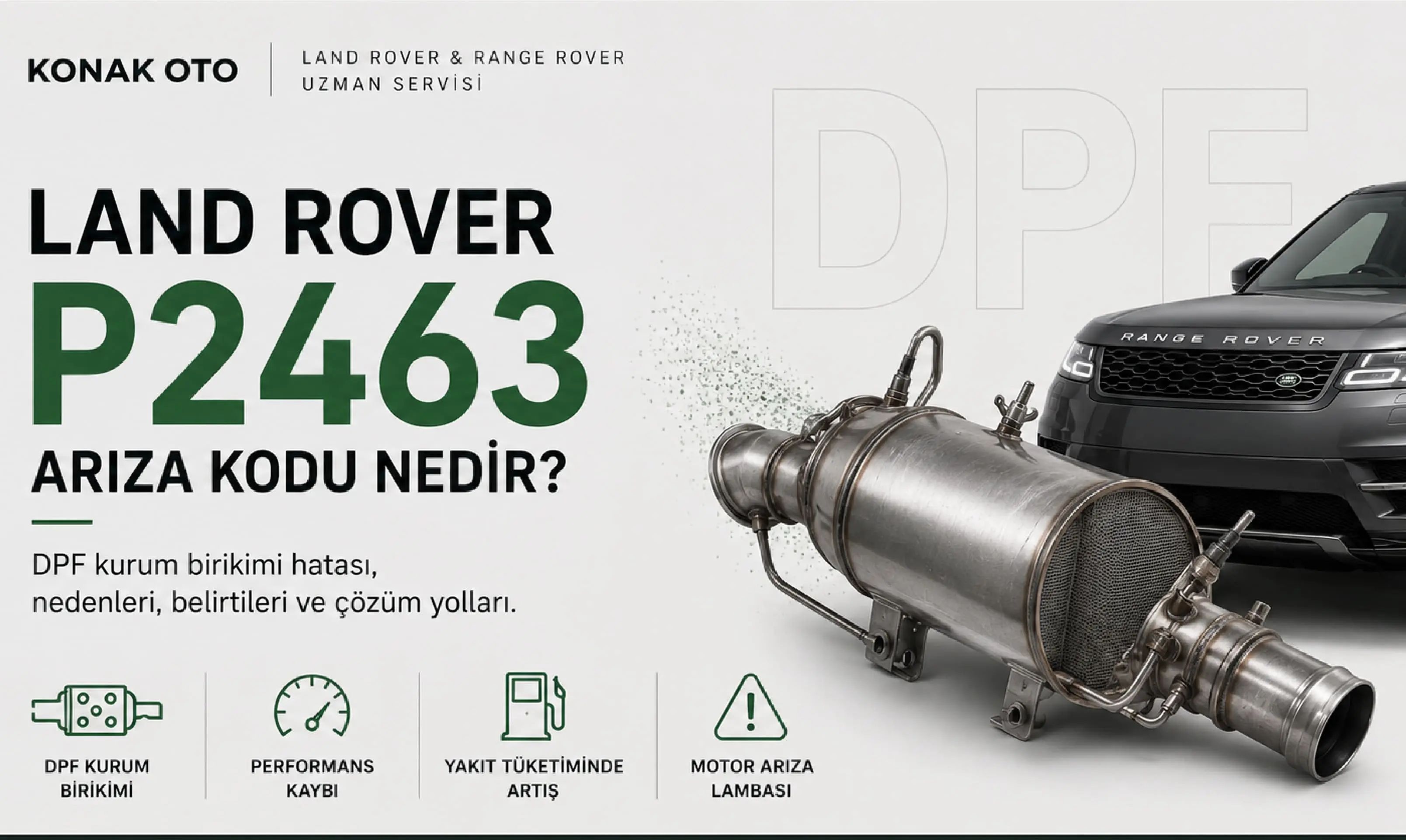
The Land Rover P2463 fault code indicates that the Engine Control Unit (ECU) has detected excessive soot accumulation inside the Diesel Particulate Filter (DPF). This condition is commonly caused by incomplete regeneration cycles, frequent short-distance driving, sensor faults, or other issues affecting the emission control system. Accurate diagnosis requires analysing DPF soot load, differential pressure values, regeneration history, and live engine data.
Table of Contents
- What Does the P2463 Fault Code Mean?
- How Does the DPF System Work?
- What Is DPF Regeneration?
- Symptoms of the P2463 Fault Code
- What Causes the P2463 Fault?
- How Is the P2463 Fault Diagnosed?
- What Happens If the Fault Is Ignored?
- How Can You Prevent P2463?
- Konak Oto's DPF Diagnostic Process
- Conclusion
- Frequently Asked Questions
Land Rover P2463 Fault Code: DPF Soot Accumulation Causes, Symptoms & Solutions
The P2463 fault code is one of the most common emission-related Diagnostic Trouble Codes (DTCs) found in diesel-powered Land Rover and Range Rover vehicles. It indicates that the Engine Control Unit (ECU) has detected excessive soot accumulation inside the Diesel Particulate Filter (DPF).
The DPF is designed to capture soot particles produced during diesel combustion before they are released into the atmosphere. As soot accumulates inside the filter, the vehicle periodically performs a regeneration process, burning off the accumulated soot at high exhaust temperatures.
If regeneration repeatedly fails or another system prevents the filter from cleaning itself efficiently, soot loading may reach a critical level. At this point, the ECU stores the P2463 Diagnostic Trouble Code, illuminates the Check Engine Light, and in some cases activates Limp Mode to protect the engine and emission system.
Many vehicle owners immediately assume that the DPF must be replaced. In reality, excessive soot loading can also be caused by unsuccessful regeneration cycles, faulty differential pressure sensors, exhaust temperature sensor failures, EGR system faults, turbocharger issues, or excessive soot production from the engine itself.
Professional diagnostics are therefore essential before considering DPF replacement.
What Does the P2463 Fault Code Mean?
P2463 is a generic OBD-II Diagnostic Trouble Code defined as:
"Diesel Particulate Filter Restriction – Soot Accumulation."
Simply put, the ECU has calculated that the soot level inside the DPF has exceeded acceptable operating limits.
However, this code does not automatically indicate that the DPF requires replacement.
It simply confirms that excessive soot accumulation has been detected.
The underlying cause must be identified before any repairs are recommended.
Information Box
P2463 Is a Result Code
The P2463 fault may be triggered by:
- Incomplete regeneration cycles
- Frequent short-distance driving
- EGR system faults
- Turbocharger problems
- Differential pressure sensor faults
- Exhaust temperature sensor failures
- Excessive engine soot production
The DPF itself is not always the root cause.
How Does the DPF System Work?
The Diesel Particulate Filter (DPF) is designed to trap soot particles produced during diesel combustion.
As soot accumulates, the ECU continuously monitors filter loading using multiple sensors.
When soot reaches a predetermined level, the vehicle initiates a regeneration process to burn the soot into ash, restoring the filter's capacity.
A typical Land Rover DPF system includes:
- Diesel Particulate Filter
- Differential Pressure Sensor
- Exhaust Gas Temperature Sensors
- Engine Control Unit (ECU)
- Fuel Injection System
- Turbocharger
- EGR System
Any malfunction affecting these components may eventually trigger the P2463 fault code.
What Is DPF Regeneration?
DPF regeneration is the process of removing accumulated soot by increasing exhaust gas temperatures.
Land Rover vehicles generally use three types of regeneration.
Passive Regeneration
During sustained highway driving, exhaust temperatures naturally become high enough to burn soot without driver intervention.
Active Regeneration
When soot loading reaches a calculated threshold, the ECU actively raises exhaust temperatures by modifying engine operation.
This process burns accumulated soot and restores normal filter performance.
Service Regeneration
If soot loading becomes too high, automatic regeneration may no longer be possible.
In these situations, a controlled service regeneration may be performed using manufacturer-approved diagnostic equipment, provided system conditions allow it.
Symptoms of the Land Rover P2463 Fault Code
Common symptoms include:
- Illuminated Check Engine Light
- Reduced engine performance
- Poor acceleration
- Increased fuel consumption
- Frequent regeneration attempts
- Cooling fan operating longer than normal
- Changes in exhaust smell
- Limp Mode activation
Some vehicles display only the warning light, while others experience noticeable power loss.
Reduced Engine Performance
As soot accumulates inside the DPF, exhaust flow becomes increasingly restricted.
This may result in:
- Reduced power
- Poor throttle response
- Lower acceleration
- Reduced turbo efficiency
Increased Fuel Consumption
Repeated regeneration attempts require additional fuel injection, which may increase fuel consumption, especially during urban driving.
Limp Mode
If soot loading reaches a critical level, the ECU may activate Limp Mode to protect the engine and emission system.
Engine output is reduced until the underlying problem is diagnosed and corrected.
What Causes the P2463 Fault Code?
Several different conditions may trigger excessive soot accumulation.
Common causes include:
Frequent Short-Distance Driving
Short journeys often prevent the engine and exhaust system from reaching temperatures required for successful regeneration.
Failed Regeneration Cycles
Repeatedly interrupting regeneration by switching off the engine before completion allows soot levels to continue increasing.
Differential Pressure Sensor Faults
The ECU calculates DPF loading using differential pressure measurements.
Incorrect sensor readings may trigger false soot accumulation calculations.
Exhaust Gas Temperature Sensor Failures
Accurate exhaust temperature measurements are essential for regeneration.
Faulty sensors may prevent regeneration from completing successfully.
Turbocharger or EGR System Problems
Poor combustion efficiency caused by turbocharger or EGR faults may increase soot production, accelerating DPF loading.
Expert Insight
In many Land Rover vehicles displaying P2463, the DPF itself is functioning correctly.
Instead, another engine or emission system fault is causing excessive soot production or preventing successful regeneration.
Professional diagnostics should always identify the underlying cause before recommending DPF cleaning or replacement.
How Is the P2463 Fault Diagnosed?
Professional diagnosis includes far more than reading the fault code.
A complete diagnostic procedure generally includes:
- Reading Diagnostic Trouble Codes (DTCs)
- Freeze Frame analysis
- DPF soot load evaluation
- DPF ash load assessment
- Differential pressure sensor testing
- Exhaust temperature sensor verification
- Regeneration history analysis
- Live Data monitoring
- Turbocharger inspection
- EGR system evaluation
- Fuel injection system assessment
Only after analysing these systems together can the actual cause be identified.
Freeze Frame Analysis
The ECU records operating conditions at the exact moment the fault occurred.
Typical recorded values include:
- Engine RPM
- Coolant temperature
- Vehicle speed
- Engine load
- DPF soot loading
- Differential pressure
- Exhaust temperature
These values help technicians understand the conditions that triggered the fault.
Live Data Analysis
Professional diagnostics compare:
- DPF soot load
- DPF ash load
- Differential pressure
- Exhaust gas temperatures
- Regeneration status
- Turbo boost pressure
- MAP sensor values
- MAF sensor readings
This information determines whether the DPF is genuinely overloaded or whether another fault is affecting the system.
Information Box
Does P2463 Always Require DPF Replacement?
No.
Many vehicles displaying P2463 may be repaired through:
- Service regeneration
- Professional DPF cleaning
- Sensor replacement
- EGR repair
- Turbocharger repair
DPF replacement should only be considered after confirming that the filter has reached the end of its service life.
What Happens If the P2463 Fault Is Ignored?
Ignoring excessive DPF soot loading may eventually lead to:
- Reduced engine performance
- Higher fuel consumption
- Increased exhaust back pressure
- Limp Mode activation
- Reduced turbo efficiency
- Additional emission system faults
Early diagnosis helps prevent more extensive repairs.
How Can the P2463 Fault Be Prevented?
The likelihood of developing P2463 may be reduced by:
- Following scheduled maintenance intervals
- Allowing regeneration cycles to complete
- Avoiding constant short-distance driving
- Using manufacturer-approved engine oil
- Addressing Check Engine Lights promptly
- Maintaining a healthy EGR and turbocharger system
Proper maintenance significantly improves DPF longevity.
Professional DPF Diagnostics at Konak Oto
At Konak Oto, P2463 diagnostics involve far more than clearing fault codes.
Our technicians perform:
- Complete electronic diagnostics
- DPF soot and ash load analysis
- Differential pressure sensor testing
- Exhaust temperature monitoring
- Live Data evaluation
- Regeneration history analysis
- Turbocharger inspection
- EGR system diagnostics
- Service regeneration assessment when appropriate
Our goal is to identify the root cause of excessive soot accumulation rather than replacing components unnecessarily.
Experience Matters
Since 1996, Konak Oto has specialised exclusively in Land Rover and Range Rover vehicles.
Every P2463 fault is evaluated according to the specific model, engine type, service history, and live diagnostic data, ensuring accurate diagnosis and effective repair planning.
Conclusion
The P2463 Diagnostic Trouble Code indicates excessive soot accumulation inside the Diesel Particulate Filter, but it does not automatically mean the DPF has failed.
Failed regeneration cycles, sensor issues, EGR faults, turbocharger problems, and excessive soot production may all contribute to this condition.
Professional diagnostics help identify the underlying cause, avoid unnecessary DPF replacement, and restore the vehicle's performance and emission system efficiency.
Frequently Asked Questions
Can I continue driving with a P2463 fault code?
The vehicle may continue operating, but performance may decrease and Limp Mode may activate. A professional diagnostic inspection is recommended as soon as possible.
Does P2463 mean the DPF is completely blocked?
No. The code indicates excessive soot accumulation, but the actual condition of the filter must be verified through diagnostic testing.
Will a service regeneration always solve the problem?
Not necessarily. If another fault prevents successful regeneration, the underlying issue must be repaired first.
Can short-distance driving cause P2463?
Yes. Frequent short trips may prevent the DPF from completing regeneration cycles, allowing soot to accumulate over time.
Can the P2463 fault return after repair?
Yes. If the root cause of excessive soot production is not corrected, the DPF may become overloaded again in the future.