
 TR
Why Does the Land Rover Coolant Level Low Warning Appear?
Why does Coolant Level Low appear? Learn about fluid loss, sensor faults, safe first steps and diagnosis of the Land Rover cooling system.
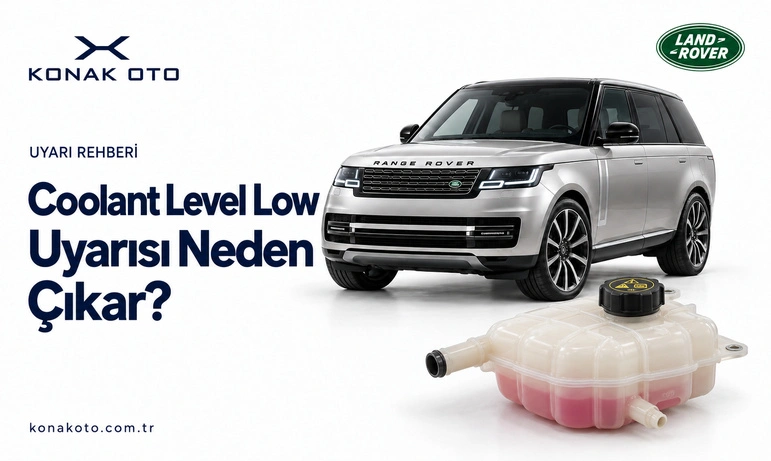
Why Does the Land Rover Coolant Level Low Warning Appear?
The Land Rover Coolant Level Low warning indicates that the vehicle has detected a low coolant level. Actual fluid loss, a change in level after filling, or a problem with the level sensor and its connections may need investigation. The message alone does not identify a faulty part. If there is overheating, steam or rapid coolant loss, stop in a safe place and contact roadside assistance. Do not open the expansion tank cap while the engine is hot. A recurring warning needs a technical assessment even when the level appears correct. [1, 2, 5, 10]
Coolant Level Low warning at a glance
· The message indicates that a low coolant level has been detected.
· The first distinction is between actual fluid loss and a problem with level detection.
· Check the level only when the engine and cooling system are completely cold.
· Continuing to drive with an overheating warning, a significant leak or rapid fluid loss increases the risk of engine damage.
· Clearing the warning or repeatedly topping up does not repair the underlying cause.
What does Coolant Level Low mean? Is it the same as overheating?
Coolant carries heat from the engine through the cooling system. An appropriate antifreeze mixture also provides protection against freezing and corrosion. Although people sometimes call it “engine water”, the fluid in the system is not simply water. [7]
Coolant Level Low concerns the fluid level. Engine Overheating or a red engine temperature warning concerns excessive temperature. They may appear together, but they convey different information. The absence of an overheating warning does not mean a low coolant level can safely be ignored. [1, 2]
For general overheating causes, read What Causes Engine Overheating in Range Rover Vehicles?.
What should you do first when the warning appears?
If there is overheating, steam or a significant leak
Stop in a safe place. With overheating and significant coolant loss, switch off the engine, contact roadside assistance and obtain technical guidance before restarting. Do not open the hot system to check it or add fluid. Land Rover's handbook calls for qualified assistance before continuing when the red engine temperature warning appears. [1, 2]
If only the level message is displayed
Record the complete message and the conditions in which it appeared. Park safely on level ground. Once the engine and system are completely cold, check the reservoir identified in the vehicle's own handbook. Where visible, read the level through the outside of the tank. The fluid must meet the level markings specified for that vehicle. Do not begin a long journey on the assumption that the vehicle can go a little further. [1]
If the level looks correct but the warning returns
Do not add fluid above MAX in an attempt to remove the message. Once the actual level has been confirmed, the sensor, connections and wiring may require assessment. Tell the workshop whether the warning is continuous or intermittent and what was done during the latest service. [5, 9, 10]
What are the possible causes of a Land Rover Coolant Level Low warning?
A leak from a hose, connection, radiator or coolant pump
A leak from an external cooling system component can reduce the fluid level. Depending on the vehicle's layout, the workshop inspects hoses, connections, the radiator and the area around the coolant pump. A pressure test may follow the visual inspection when needed. Not every inspected component requires replacement. [3, 4]
If fluid is visible beneath the vehicle, record its location and when it appears. The absence of a visible drip does not prove that the system is leak-free. Diagnosis should not rely solely on the appearance of the parking surface.
A problem with the expansion tank or its cap
Cracks or sealing problems in the expansion tank can cause fluid loss. The cap also forms part of the system's pressure regulation. The tank, cap and connections should be assessed together. The warning alone is not a basis for immediately replacing the cap or reservoir. [9]
Coolant loss that is not obvious externally
An investigation should not end simply because no visible leak was found. More extensive testing may be appropriate for the engine and complaint. For example, JLR's 2013 bulletin LTB00502NAS2 addresses possible coolant loss through threaded cylinder head core plugs on specified Evoque and LR2 vehicles. This is not a diagnosis that applies to every Land Rover. [6]
The Coolant Level Low message therefore does not establish that the cylinder head gasket has failed. Suspected internal loss is assessed alongside other checks and appropriate test findings.
A fault with the level sensor, connector or wiring
A message displayed despite a correct level may require inspection of the level detection circuit. JLR's SSM 76361 guidance addresses this condition through sensor connection and earth circuit checks on specified 2022–2025 Range Rover and 2023–2025 Range Rover Sport vehicles. [5]
This example does not mean every warning has an electrical cause. First confirm the actual level in the correct reservoir, then follow the test plan applicable to the vehicle. The coolant level sensor and coolant temperature sensor perform different functions. For an explanation concerning temperature data, see Land Rover P0116 Fault Code. [3, 5]
Incomplete filling or trapped air after service
After coolant replacement or cooling system repair, the filling and bleeding procedures should be checked. Trapped air can affect circulation and cooling performance. The level, leak-tightness and operation must be checked after the work according to the vehicle's procedure. Recurring loss should not be dismissed simply as air leaving the system. [4]
Which coolant should be used?
The correct fluid depends on the model year, engine and manufacturer's specification. Do not choose antifreeze solely because its colour matches. Confirm the required approval, whether the product is premixed or concentrated, and its filling instructions. Adding extra water to a premixed product without checking those instructions is inappropriate. [7, 11]
One product, mixture ratio or replacement interval should not be recommended for every Land Rover model. Compatibility between different fluids must also be checked against the manufacturer's information. Coolant is required throughout the year for corrosion protection and temperature management, rather than only in winter. [7]
Do not make topping up with water alone a routine maintenance habit. Any emergency top-up decision should follow the vehicle's handbook and technical guidance. Do not use leak-stopping additives as a substitute for diagnosis and repair; these products can affect passages in the system. [4, 7]
Why do the model, model year and hybrid equipment matter?
The reservoir layout, fluid requirements and test steps may differ between Range Rover, Range Rover Sport, Velar, Evoque, Discovery, Discovery Sport and Defender vehicles. Give the workshop the model, model year, engine and details of the latest coolant work. Bulletin applicability is checked using the VIN and current manufacturer information.
Which cooling circuit is being checked on a PHEV?
On a plug-in hybrid, the relevant cooling circuit must be identified correctly. JLR's 2023 document SSM75965 separately addresses low fluid levels in the high-voltage cooling circuit of certain PHEVs and possible accompanying battery messages. Do not add fluid to a reservoir chosen at random; obtain technical confirmation of the affected circuit. The message alone does not prove that the high-voltage battery is faulty. [8]
The JLR bulletins referenced here are examples with limited coverage. Work on a vehicle in Türkiye must be selected using the current technical information applicable to that vehicle.
How is a Coolant Level Low warning diagnosed correctly?
The following sequence is a general approach to organising the workshop assessment. The scope of testing depends on symptoms and vehicle information. [3, 10]
1. Record the complaint. Establish warning frequency, whether overheating occurred, how much fluid was added and what recent service work was performed.
2. Confirm the actual level and fluid. Identify the correct circuit and reservoir, then check the cold-system level, fluid suitability and visible traces.
3. Investigate the source of loss. Where necessary, test the system and cap using the manufacturer's method. If no external leak is found, select further tests according to the vehicle and findings.
4. Assess the detection circuit. If the level is correct but the warning continues, inspect the sensor, connector, wiring and relevant records. Clearing fault codes does not replace a physical level check.
5. Verify the result after the work. Following repair, correct filling and any required bleeding, check leak-tightness, fluid level and whether the warning returns.
Read What Is Land Rover Diagnostic Fault Detection? for more information about diagnosis.
How is the Coolant Level Low warning resolved?
The solution depends on the confirmed cause. A leak requires repair of the affected component. A filling problem requires completion of the procedure appropriate to the vehicle. A detection fault calls for the necessary electrical or sensor work. Replacing the same component for every warning is not an appropriate approach.
Even if the message disappears after topping up, check whether the level drops again. Recording the quantity added, date and mileage helps subsequent assessment. Do not postpone a workshop inspection when repeated topping up is required.
Why do inspection and repair prices vary?
A basic level check, pressure test, electrical investigation and investigation of internal coolant loss involve different scopes of work. Cost depends on the model, required parts, labour and test findings. A photograph of the message cannot establish an exact repair price or completion time.
Frequently asked questions
Can you drive with a Coolant Level Low warning?
There is no single safe distance or duration. If there is overheating, steam, a significant leak or rapid level loss, do not continue driving and contact roadside assistance. Even with only a level message, assess the actual level and vehicle instructions before continuing. [1, 2]
Why does the warning appear when the coolant level is correct?
A sensor or connection problem is possible. First confirm the correct level in the proper reservoir with the system cold. Do not overfill the tank to suppress the message. [5, 9, 10]
Is a warning that appears only in cold weather normal?
Appearing only at a particular temperature does not mean there is no fault. Record the conditions and have the cold level and detection circuit assessed. It is inappropriate to treat this as a harmless seasonal message on every vehicle.
Will adding antifreeze definitely solve the warning?
No. An actual low level may require appropriate topping up, but a leak, incomplete filling or a detection fault needs separate attention. Confirm the product and required quantity before adding fluid.
Does a normal temperature gauge mean there is no problem?
A normal temperature indication does not prove that the coolant level is sufficient or the system is leak-free. Level and temperature information should be assessed together. [1, 3]
Can the expansion tank cap be opened while the engine is hot?
No. Pressurised hot fluid and steam can cause serious burns. Wait until the engine and system are completely cold before checking or working on the system. [1]
Land Rover cooling system assessment in Maslak
If your Land Rover or Range Rover repeatedly displays Coolant Level Low, contact Konak Oto. Give our workshop at Maslak Atatürk Oto Sanayi Sitesi the model, model year, a photograph of the message and details of recent coolant work.
If there is overheating or rapid coolant loss, discuss roadside assistance and transport rather than driving to the workshop. The workshop assessment establishes the necessary tests, scope of work and estimated cost.
Book a service appointment · Explore our engine system service
Related articles
· What Causes Engine Overheating in Range Rover Vehicles?
· What Is Land Rover Diagnostic Fault Detection?
· Land Rover P0116 Fault Code and the Coolant Temperature Sensor
Sources
1. Land Rover — Checking and topping up coolant, Freelander 2 handbook
2. Land Rover — Red engine temperature and Engine Overheating warning
3. HELLA — Cooling system checks and diagnosis
4. HELLA — Filling, bleeding and testing cooling system leak-tightness
5. JLR — SSM 76361, intermittent low coolant warning with a correct level, 2025 guidance
6. JLR — LTB00502NAS2, unexplained coolant loss, 12 February 2013
7. HELLA — Coolant, antifreeze and manufacturer specifications
8. JLR — SSM75965, PHEV cooling circuit level concerns, 13 March 2023
9. HELLA — Expansion tanks and pressure regulation
10. JLR — JLRTB02127NAS4, level, sensor and leak checks for a low coolant message, 8 January 2025
11. BASF GLYSANTIN — Concentrated and ready-to-use coolants
This guide provides general information. The vehicle's own handbook and current manufacturer procedure take priority. Decisions about an individual vehicle require a technical assessment.